
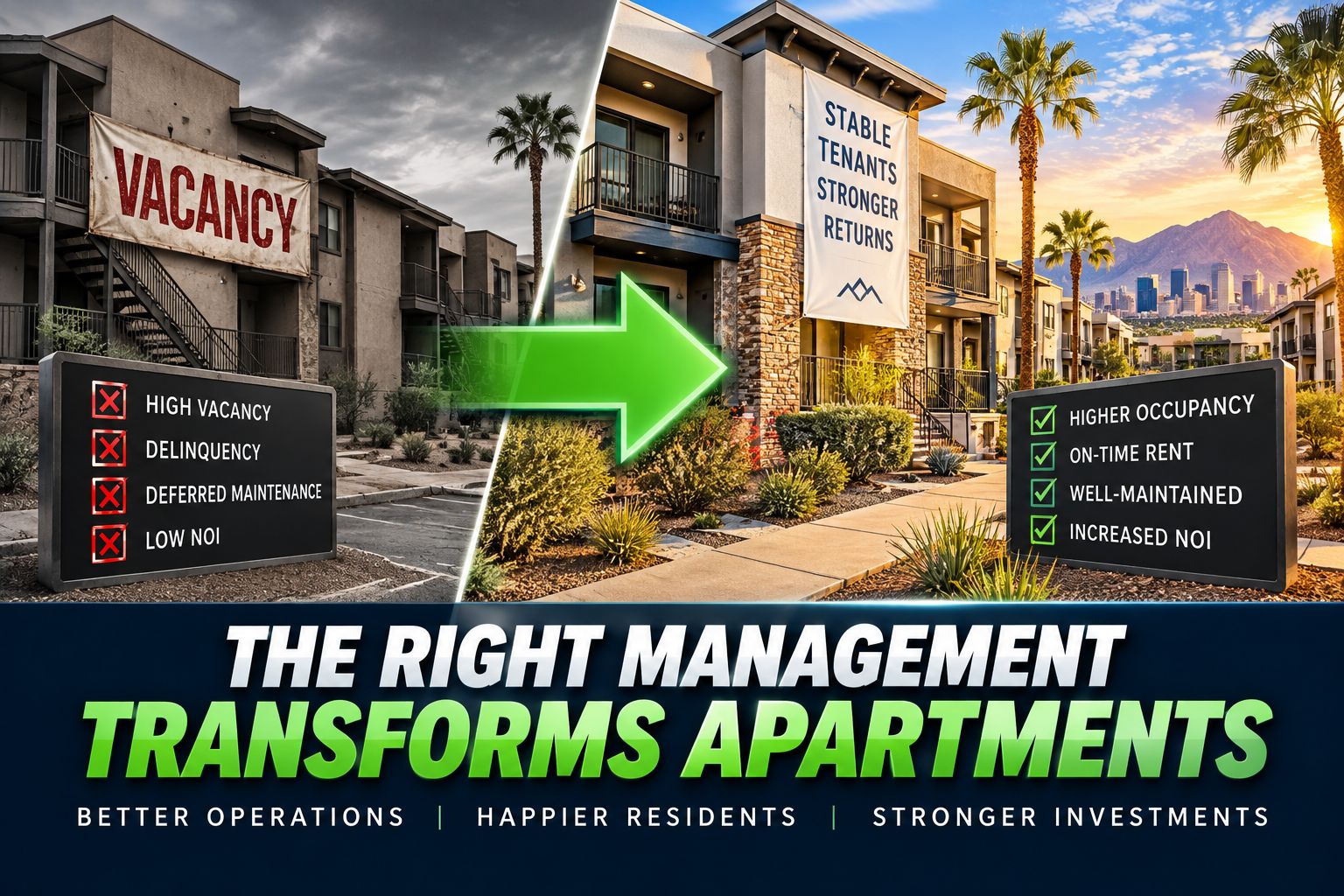
Choosing the right property management company can have a significant impact on the performance of a multifamily investment.
For owners of apartment communities in Phoenix, good property management goes well beyond collecting rent and responding to maintenance requests. Your management company has a direct impact on occupancy, rental rates, resident retention, operating expenses, property condition and ultimately the NOI and value of your property.
Unfortunately, not all property management companies operate the same way.
Some companies are primarily designed around single-family rental homes. Others specialize in large institutional apartment communities with hundreds of units and substantial on-site teams. For owners of small to midsize multifamily properties, neither model is always the right fit.
If you're interviewing companies for multifamily property management in Phoenix, here are some of the things we believe owners and investors should consider before making a decision.
1. Make Sure They Actually Understand Multifamily
This sounds obvious, but managing an apartment community is very different from managing a portfolio of scattered single-family homes.
With multifamily, small operational problems can quickly become expensive when they're multiplied across 20, 50, 100 or more units.
Leasing needs to be closely monitored. Vacant units need to be turned quickly. Delinquencies need immediate attention. Maintenance has to be prioritized and coordinated efficiently. Common areas and property appearance matter. Vendors need to understand the property. Renewals need to be evaluated against current market conditions.
There also needs to be someone looking at the property as a whole—not simply managing 50 individual leases.
When interviewing a management company, ask about the multifamily properties they currently manage. What size are they? What type? Do they have experience with Class B and C properties? Value-add projects? Older properties with deferred maintenance?
You want to know whether your property fits into what they actually do every day.
2. Understand How They Approach Leasing and Vacancy
Vacancy is one of the fastest ways to hurt the performance of an apartment property.
A management company should be able to clearly explain its leasing process from the day notice is received through the day the next resident moves in.
That includes determining the appropriate rental rate, advertising the unit, responding to leads, conducting showings, processing applications, coordinating the make-ready and getting the lease signed.
One area we pay particular attention to is the overlap between leasing and maintenance.
You can generate all the leads in the world, but if a vacant unit takes three weeks to become rent-ready, you're still losing money.
Likewise, turning a unit in three days doesn't accomplish much if the asking rent is unrealistic and it sits vacant for another 45 days.
Good multifamily management requires both sides of that equation to work together.
Ask prospective managers how they track vacant units, days on market, upcoming notices, make-ready status and leasing activity.
More importantly, ask who is responsible when something isn't moving fast enough.
3. Look Closely at Their Maintenance Operation
Maintenance is usually one of the biggest frustrations we hear about from apartment owners.
It's also one of the areas where management can have the greatest impact on operating expenses and resident satisfaction.
Ask how maintenance requests are received, prioritized and tracked.
Who handles the work? Does the company have in-house maintenance, dedicated vendors or a combination of both? Who follows up on incomplete work orders? Who reviews invoices? How are larger repairs approved?
For multifamily properties, we also believe management should be looking beyond individual work orders.
That means paying attention to recurring plumbing issues, HVAC problems, property appearance, pools, landscaping, roofs, common areas and preventive maintenance.
If the same repair keeps occurring in multiple units, someone should be asking why.
The goal shouldn't simply be to close work orders. It should be to maintain the property while controlling long-term costs.
4. Ask How They Manage Delinquency
Every management company will tell you they collect rent.
The better question is: What happens when someone doesn't pay?
A strong delinquency process should begin immediately after rent is due. Residents should receive consistent communication, notices should be served on schedule and management should have a defined process for payment arrangements, legal action and eviction when necessary.
Consistency is especially important in multifamily.
Allowing delinquency to linger doesn't just create a collections problem. It can negatively affect cash flow and make it much harder to regain control of a property that already has operational issues.
If you're acquiring a property with significant existing delinquency, this becomes even more important.
Ask the management company to walk you through exactly what happens from the first missed payment through resolution.
5. Make Sure You Understand the Accounting and Reporting
Owners should be able to understand how their property is performing without spending hours trying to decipher financial reports.
At a minimum, your management company should be able to provide clear monthly financial statements, rent rolls, delinquency reports, general ledgers, income and expense reporting and supporting documentation.
But software alone doesn't create good accounting.
Ask who reviews the property's financials and how discrepancies are handled. Ask how invoices are approved and coded. Ask how security deposits are managed and how owner distributions work.
For larger multifamily properties, budgeting and ongoing expense monitoring become increasingly important.
We also recommend discussing reporting expectations before signing a management agreement. Different owners want different levels of information, and it's much easier to establish those expectations at the beginning of the relationship.
6. Don't Choose Based on Management Fee Alone
Management fees matter. They just shouldn't be the only factor.
A management company charging slightly less but allowing units to remain vacant longer, failing to follow up on delinquency or poorly controlling maintenance expenses can cost an owner considerably more than the difference in management fees.
Owners should also understand the entire fee structure.
Ask about management fees, leasing fees, renewal fees, maintenance markups, administrative charges, setup fees and any other costs that could affect the property.
There isn't necessarily one "correct" fee structure.
The important thing is understanding what you're paying and what you're getting for it.
7. Find Out Who Will Actually Manage Your Property
This is one of the most overlooked questions in the interview process.
The person selling you on the company may not be the person you'll work with after signing the agreement.
Ask who your primary contact will be.
Who handles leasing? Who oversees maintenance? Who reviews the financials? Who visits the property? Who communicates with residents? Who do you call when there's a serious problem?
For properties requiring on-site staff, ask how those employees are managed and who is responsible for their performance.
You should understand the organizational structure before turning over the keys.
8. Communication Style Matters
Some owners want frequent communication and involvement in day-to-day decisions. Others want the management company to operate the property and contact them primarily for major decisions.
Neither approach is necessarily wrong.
The problem occurs when the owner's expectations and the management company's operating style don't match.
We believe a good property management relationship requires establishing those expectations early.
How often will you receive updates? Which decisions require owner approval? What repair authorization limits will be established? Who handles emergencies? How quickly should you expect responses?
These may seem like small details during the interview process, but they become very important once management begins.
9. If You're Buying a Property, Bring Management in Early
One mistake we see investors make is waiting until just before closing to select a property management company.
An experienced multifamily manager can often provide valuable operational insight during due diligence.
They may identify unrealistic rent assumptions, unusual expenses, deferred maintenance, staffing issues, delinquency concerns or opportunities to improve the property's performance.
A broker looks at the transaction.
A lender looks at the financing.
A property manager should be looking at what happens the morning after you own it.
Even if you haven't closed yet, getting a management company involved early can help you develop a more realistic operating plan.
10. Look for a Manager Who Thinks Like an Owner
Ultimately, this may be the most important factor.
Good multifamily property management isn't about completing a checklist of tasks. It's about understanding how all of those individual decisions affect the investment.
Should you push rents another $75 or prioritize occupancy?
Does it make sense to repair that HVAC unit again or replace it?
Should you spend money improving a common area?
Why are turns taking longer than they should?
Why has maintenance expense increased?
Why aren't certain floorplans leasing?
A good property manager should be asking these questions before the owner has to.
Choosing the Right Phoenix Multifamily Property Manager
There are a lot of property management companies in the Phoenix market, and no single company is the right fit for every apartment owner.
Take the time to interview several companies and ask specific questions about how they actually operate properties like yours.
At Mosaic Property Management, our multifamily division focuses on apartment communities throughout the Phoenix metro area, with particular experience managing Class B and C properties, value-add opportunities and small to midsize multifamily communities.
We're a local, family-owned company, and our owners remain actively involved in the business. Our goal isn't simply to collect rent and process work orders. We want to understand what an owner is trying to accomplish with the property and manage it accordingly.
Whether you're considering a new acquisition, aren't satisfied with your current management company or simply want a second opinion on how your property is performing, we're always happy to have a conversation.
Looking for multifamily property management in Phoenix? Contact Mosaic Property Management to talk with our team about your property and see if we're the right fit.
